
Ultimate Guide to Water Purifier 2026
Clean drinking water is not a luxury — it is a right. Yet across India, millions of households drink water laced with bacteria, heavy metals, excess TDS, and chemical contaminants every single day. A good water purifier is your last line of defence.
This guide covers everything: technology comparisons, how to choose by water source, what TDS means, installation tips, maintenance, top brand comparisons, and budget recommendations. Bookmark it — you will refer back to it.
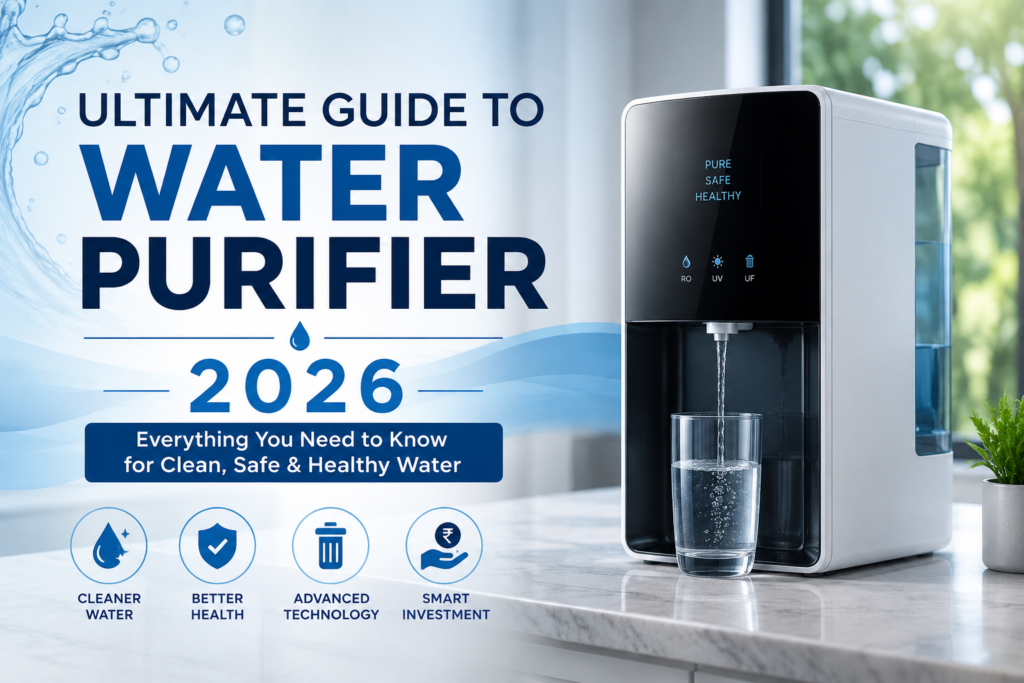 Comprehensive Water Purifier Buying Guide 2026 Infographic showing RO, UV, UF purifier types with water source matching and TDS ranges Comprehensive Water Purifier Buying Guide 2026 Infographic showing RO, UV, UF purifier types with water source matching and TDS ranges |
1. Why Water Purification Matters in India
India’s groundwater crisis is worsening. The Central Ground Water Board reports that over 60% of districts have groundwater with contamination above permissible limits. The contaminants vary drastically by region:
- Northern plains: High TDS, arsenic, fluoride
- Coastal areas: High salinity, chloride
- Urban metros: Bacterial contamination, chlorine by-products
- Industrial zones: Heavy metals (lead, chromium, mercury)
- Rural areas: Nitrates from fertilisers, microbial contamination
The WHO estimates that 80% of diseases in developing countries are water-borne. Typhoid, cholera, dysentery, and hepatitis A are all preventable with proper water treatment. This is not fear-mongering — it is the reality of India’s water supply landscape.
2. Types of Water Purification Technologies
Understanding the core technologies helps you make a smarter purchase decision.
| Technology | What It Removes | Best For | Limitation |
| RO (Reverse Osmosis) | TDS, heavy metals, bacteria, viruses, fluoride, arsenic | High TDS (>300 ppm) borewell/municipal water | Wastes 3–4 litres per litre purified; removes minerals too |
| UV (Ultraviolet) | Bacteria, viruses, cysts | Low TDS municipal water with bacterial issues | Does NOT remove TDS, chemicals, or dissolved solids |
| UF (Ultrafiltration) | Bacteria, cysts, suspended solids | Low TDS, mildly contaminated water | Does NOT remove dissolved impurities or viruses |
| MF (Microfiltration) | Large particles, some bacteria | Pre-filter stage | Cannot handle fine contaminants |
| Activated Carbon | Chlorine, odour, organic compounds | Taste/odour improvement, pre/post filter | Does not remove dissolved solids or bacteria |
| Alkaline / Ionizer | Adds minerals, adjusts pH | Health-focused users | No purification on its own; often marketing-driven |
3. How to Choose the Right Purifier for Your Water Source
The single most important factor in choosing a purifier is your water source and its TDS level. Here is a quick decision framework:
| Water Source | Typical TDS Range | Recommended Technology |
| Municipal tap water | 50–300 ppm | UV or UF (RO if TDS > 200) |
| Borewell water | 300–2000 ppm | RO + UV + UF mandatory |
| River / surface water | Variable, high turbidity | RO + UV with sediment pre-filter |
| Mixed / tanker water | 200–800 ppm | RO + UV recommended |
| Packaged water area | Below 50 ppm | UF sufficient |
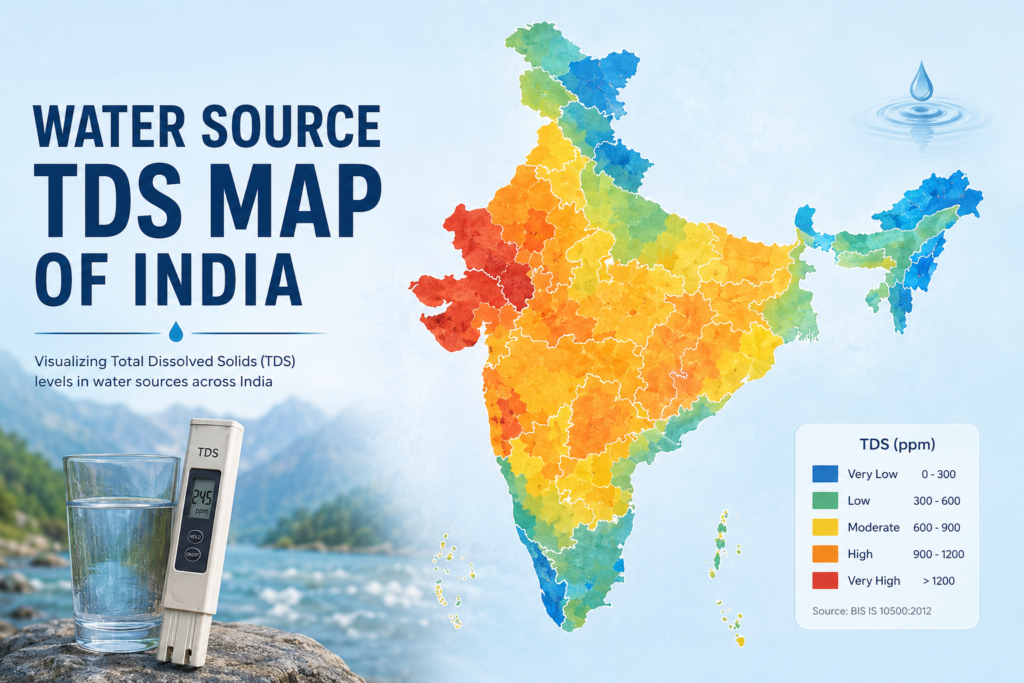 Water Source TDS Map of India Regional map showing typical TDS levels and contamination types across Indian states Water Source TDS Map of India Regional map showing typical TDS levels and contamination types across Indian states |
4. TDS: The Most Misunderstood Water Parameter
TDS stands for Total Dissolved Solids — a measure of all dissolved substances in water, expressed in parts per million (ppm) or mg/L.
Safe TDS range for drinking water (BIS/WHO): 50–300 ppm (ideal: 150–250 ppm)
Problematic: Below 50 ppm (minerals stripped), Above 500 ppm (tastes bad, may be harmful)
A common myth is that ‘zero TDS = pure water’. This is incorrect. Completely demineralised water lacks essential minerals like calcium and magnesium, and may actually leach minerals from the body. Good RO purifiers include a mineraliser cartridge to reintroduce beneficial minerals.
5. RO Purifiers: Complete Breakdown
Reverse Osmosis forces water through a semi-permeable membrane with pores of 0.0001 micron — smaller than most viruses. This makes it the most comprehensive purification technology available.
Stages in a Typical RO+UV+UF Purifier
- Stage 1 – Sediment Pre-Filter: Removes mud, sand, rust, particles above 5 microns
- Stage 2 – Activated Carbon Block: Removes chlorine, chloramines, VOCs, odour
- Stage 3 – Granular Activated Carbon (GAC): Further chemical and taste improvement
- Stage 4 – RO Membrane: Removes TDS, heavy metals, bacteria, viruses, fluoride
- Stage 5 – UV Chamber: Kills any residual microorganisms in storage tank
- Stage 6 – UF Membrane: Final bacterial safety net
- Stage 7 – Post-Carbon / Mineraliser: Adds back healthy minerals, improves taste
6. Top Water Purifier Brands in India 2025-26
| Brand | Best Model | Price Range | Strengths | Weakness |
| Kent | Kent Grand Plus | Rs 14,000–18,000 | Trusted brand, wide service network, good RO membranes | Higher rejection rate, smaller tank (8L) |
| Aquaguard (Eureka Forbes) | Aquaguard Enhance | Rs 12,000–22,000 | AMC support, innovative features, smart monitoring | Expensive AMC, premium pricing |
| Livpure | Livpure Glo Star | Rs 9,000–15,000 | Value for money, 7L tank, good TDS control | Service network smaller |
| AO Smith | AO Smith Z9 Green | Rs 18,000–28,000 | Green RO tech, side stream design, energy efficient | Premium pricing |
| Havells | Havells Digiplus | Rs 10,000–16,000 | Built-in mineraliser, digital display, reliable | After-sales varies by city |
| Blue Star | Blue Star Majesto | Rs 12,000–20,000 | Professional brand, good build quality | Less retail presence |
| Pureit (HUL) | Pureit Eco Water Saver | Rs 8,000–15,000 | Budget-friendly, HUL brand trust, eco-friendly | Smaller product range |
 Top Water Purifier Brand Comparison Chart Visual comparison of Kent, Aquaguard, Livpure, AO Smith showing features and pricing Top Water Purifier Brand Comparison Chart Visual comparison of Kent, Aquaguard, Livpure, AO Smith showing features and pricing |
7. Budget-Wise Recommendations
Under Rs 8,000
Options are limited but include basic UV or UF purifiers. Suitable only for municipal water with low TDS. Look for: HUL Pureit Classic, Tata Swach Cristella.
Rs 8,000 – Rs 12,000
Best sweet spot for most Indian households. You get full RO+UV+UF with mineraliser. Recommended: Livpure Glo, Havells Fab Plus, Pureit Eco Advanced.
Rs 12,000 – Rs 20,000
Premium purifiers with smart features, larger tanks (10–15L), and better membranes. Recommended: Kent Grand Plus, Aquaguard Enhance, Blue Star Majesto.
Above Rs 20,000
High-end solutions with alkaline water, hot/cold dispensing, app connectivity. Recommended: AO Smith Z9 Green RO, Aquaguard Marvel, Livpure Envy Plus.
8. Installation & Maintenance Essentials
Even the best purifier underperforms without proper installation and regular maintenance.
- Install near kitchen sink with access to inlet water line
- Mount storage tank at eye level or above for good flow pressure
- Change sediment and carbon filters every 3–6 months
- Replace RO membrane every 2–3 years (or 2000–3000 litres)
- Clean UV lamp sleeve annually; replace UV bulb every 8,000–10,000 hours
- Sanitise storage tank every 6 months
- Get annual AMC (Annual Maintenance Contract) from the manufacturer
9. Environmental Impact: The RO Waste Water Problem
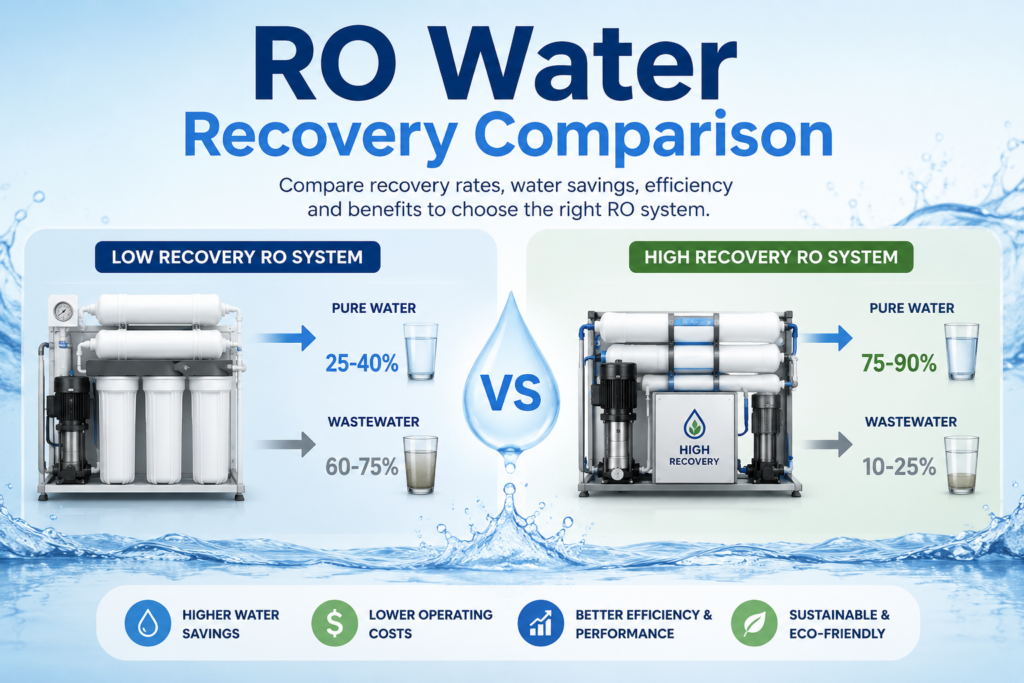
A standard RO purifier wastes 3–4 litres of water for every 1 litre purified. In a water-stressed country like India, this is significant. Look for:
- High recovery ratio purifiers (look for 1:1 or 2:1 ratio)
- Waste water recyclers — route reject water to toilets or mopping
- AO Smith’s Green RO technology claims 50% less wastage
- Some advanced models recover up to 70–75% of input water