
What Is Pure Drinking Water? Standards & Parameters Explained
‘Pure water’ is a marketing phrase that has lost all meaning. Water companies, purifier brands, and even government agencies use it freely — but what does it actually mean? The science is clear: there is no single definition of ‘pure’ water for drinking. Instead, safety is defined by specific parameters and permissible limits.
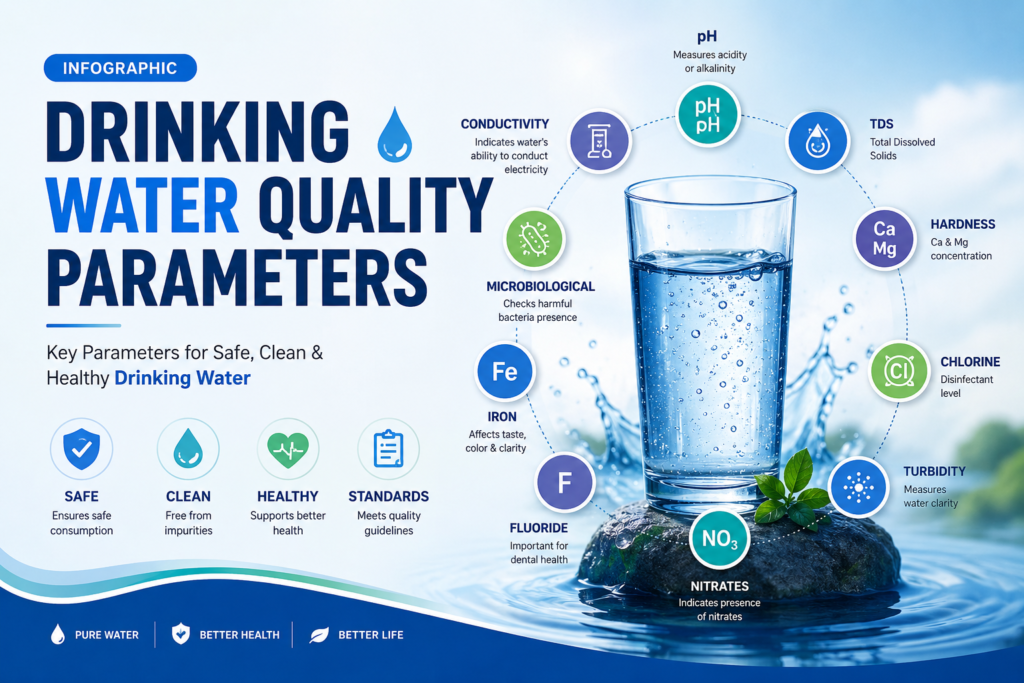 Drinking Water Quality Parameters Infographic Visual showing all key water quality parameters with safe ranges — pH, TDS, hardness, bacteria, fluoride, nitrate, etc. Drinking Water Quality Parameters Infographic Visual showing all key water quality parameters with safe ranges — pH, TDS, hardness, bacteria, fluoride, nitrate, etc. |
The Key Drinking Water Standards in India
India’s primary standard for drinking water quality is BIS IS 10500:2012, last revised in 2012. This standard sets two levels for each parameter: desirable limit (preferred) and permissible limit in absence of alternate source.
| Parameter | Desirable Limit | Permissible Limit | Health Impact if Exceeded |
| TDS (ppm) | 300 | 500 | Tastes bad, possible kidney stress long-term |
| pH | 6.5–8.5 | 6.5–8.5 (no relaxation) | Acidic <6.5 causes corrosion; alkaline >8.5 causes scaling |
| Total Hardness (ppm) | 200 | 600 | Cardiovascular effects debated; causes scale |
| Calcium (mg/L) | 75 | 200 | High calcium causes hardness; low causes bone issues |
| Magnesium (mg/L) | 30 | 100 | Excess causes diarrhoea; deficiency causes health issues |
| Fluoride (ppm) | 1.0 | 1.5 | Above 1.5: dental fluorosis; above 4: skeletal fluorosis |
| Arsenic (mg/L) | 0.01 | 0.05 | Carcinogenic with long-term exposure |
| Nitrate (mg/L) | 45 | No relaxation | Methemoglobinemia (blue baby syndrome) in infants |
| Iron (mg/L) | 0.3 | No relaxation | Stains fixtures; taste impact; promotes bacterial growth |
| Chloride (mg/L) | 250 | 1000 | Salty taste; corrosion; digestive upset in excess |
| E. coli / Coliform | Absent in 100mL | Absent — no relaxation | Cholera, typhoid, dysentery, gastroenteritis |
| Turbidity (NTU) | 1 | 5 | Indicates suspended solids; may harbour pathogens |
pH: The Acidity-Alkalinity Balance
pH measures how acidic or alkaline water is on a scale of 0–14. Pure water is exactly 7.0 (neutral). Drinking water should be between 6.5 and 8.5. Water outside this range is either:
- Too acidic (pH < 6.5): Corrosive to pipes, can leach lead and copper into water, has a slightly sour taste
- Too alkaline (pH > 8.5): Scale formation, potentially bitter taste, may affect digestion
The alkaline water trend promotes pH 8–9.5 water as ‘healthier’. Current scientific evidence does not support superior health benefits from mildly alkaline water for healthy individuals. The kidneys regulate blood pH very effectively regardless of what you drink.
Hardness: Why It Matters More Than You Think
Water hardness is caused by dissolved calcium (Ca2+) and magnesium (Mg2+) ions. Hard water is not a health risk per se — in fact, some research suggests it may be mildly cardioprotective — but it causes practical problems:
- Scale deposits in pipes, geysers, and RO membranes (reducing lifespan)
- White deposits on taps, tiles, and utensils
- Reduced soap/detergent lathering efficiency
- Bitter or chalky taste in water and tea
Microbial Safety: The Non-Negotiable Parameter
Unlike chemical parameters which have permissible limits, microbial contamination has zero tolerance. BIS IS 10500:2012 and WHO both specify that E. coli and coliform bacteria must be ABSENT in any 100mL sample of drinking water.
India’s track record on microbial water safety is poor. A 2023 study published in Nature found that over 37% of water samples from Indian households contained coliform bacteria exceeding safe limits — including in treated municipal supplies. This is why UV or UF purification is the minimum standard even for municipal water users.
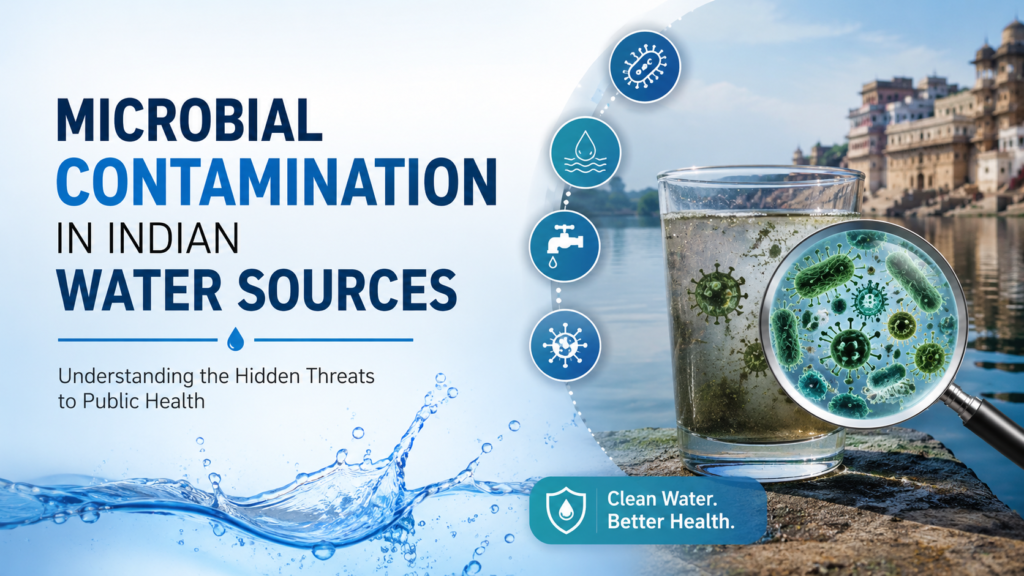 Microbial Contamination in Indian Water Sources Data visualisation showing percentage of contaminated water samples across Indian states with contamination type breakdown Microbial Contamination in Indian Water Sources Data visualisation showing percentage of contaminated water samples across Indian states with contamination type breakdown |
What About Bottled Water?
India’s packaged drinking water must comply with BIS IS 14543. The standard covers microbiological safety, chemical parameters, and packaging requirements. However, there are concerns:
- Bureau of Indian Standards (BIS) testing has found non-compliance in many smaller brands
- Plastic leaching (particularly from PET bottles stored in heat) is a concern
- Environmental cost: 1 litre of bottled water has 2,000x the carbon footprint of tap water
- Cost comparison: Rs 15,000–30,000/year for bottled water vs Rs 500/year running a home purifier
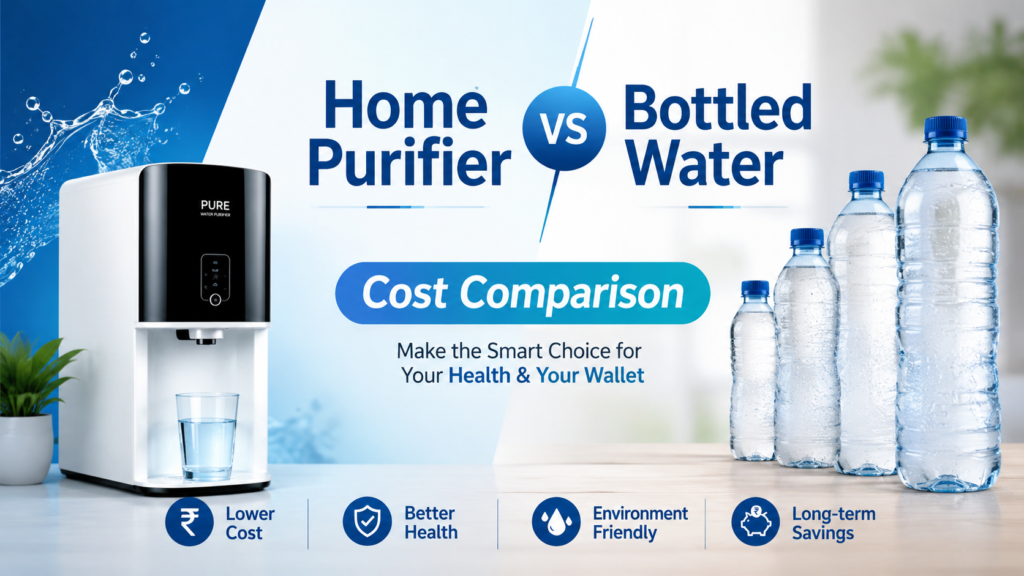 Home Purifier vs Bottled Water Cost Comparison Bar chart showing annual cost comparison of bottled water, packaged water delivery, RO purifier, and UV purifier over 5 years Home Purifier vs Bottled Water Cost Comparison Bar chart showing annual cost comparison of bottled water, packaged water delivery, RO purifier, and UV purifier over 5 years |
Frequently Asked Questions (FAQ)
Schema Markup Note: Implement the FAQPage schema (JSON-LD) for Google rich results and AI Overviews eligibility.
What is the pH of pure water?
Chemically pure water (H2O with no dissolved substances) has a pH of exactly 7.0 at 25°C. Drinking water may range between 6.5–8.5 and still be safe according to BIS standards. Natural water is rarely exactly pH 7 due to dissolved minerals and gases.
What does ‘bacteria-free water’ mean on a purifier label?
It typically means the purifier reduces bacteria to below detectable limits (effectively 99.99% or log-4 reduction). This is achieved by UV, UF, or RO stages. However, ‘bacteria-free’ is not a regulatory term — look for BIS WQD mark or NSF/ANSI certification for verified performance claims.
Is hard water bad for health?
Moderately hard water (up to 300 mg/L hardness) is not harmful and may provide some calcium and magnesium. Extremely hard water (above 600 mg/L) may cause digestive issues for some people and is a BIS permissible limit exceedance. Hard water is more of a practical nuisance (scale, pipe damage) than a health risk at moderate levels.
Is BIS-marked water purifier mandatory?
BIS certification (IS 14900 for household water purifiers) is not legally mandatory in India, but it is a strong quality indicator. Government procurement requires BIS certification. The Water Quality and Drinking Water Mission recommends BIS-marked purifiers for public distribution. Checking for BIS mark is good consumer practice.
Related Articles (Internal Links)
- Ultimate Guide to Water Purifier 2026 (Pillar Blog)
- TDS Level in Drinking Water: What Is Safe? (India Guide)
- How to Check Water Quality at Home (Free & Paid Methods)
- Water Testing Lab Near Me: How to Get Your Water Tested
- Signs Your Tap Water Is Contaminated (And What To Do)
- Is Zero TDS Water Safe to Drink? Experts Explain