
How to Check Water Quality at Home (Free & Paid Methods)
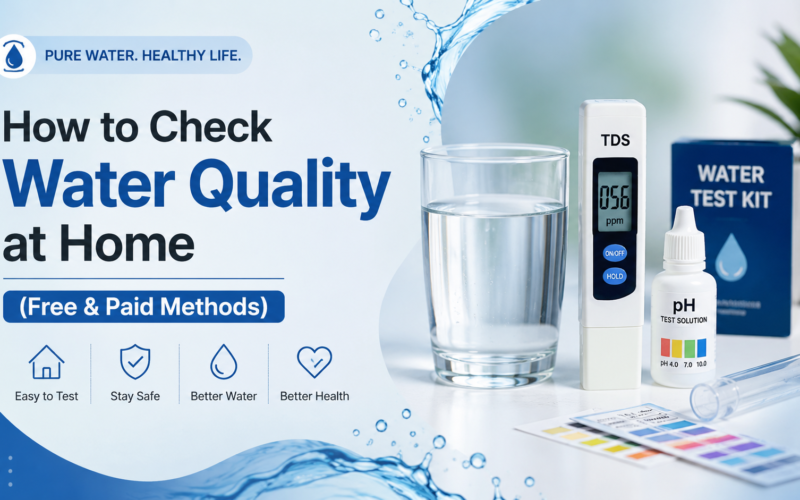
You do not need a laboratory to get a reasonable picture of your water quality. A combination of free online resources, affordable home test kits, and visual inspection can tell you a great deal about what is — and is not — in your tap water. Here is the complete toolkit.
 Water Quality Testing Methods Comparison Visual matrix showing free vs paid methods with accuracy levels, time needed, and what each tests Water Quality Testing Methods Comparison Visual matrix showing free vs paid methods with accuracy levels, time needed, and what each tests |
Free Methods: No Equipment Needed
1. Government Water Quality Reports
Most Indian municipal corporations publish annual water quality test reports. Sources:
- CGWB (Central Groundwater Board) — cgwb.gov.in — ground water quality by district
- BIS Water Quality Division — bis.gov.in — state-wise water quality standards compliance
- Your local municipal corporation website (search: ‘[City name] water quality report 2025’)
- India Water Portal (iwp.in) — community water quality data
2. Visual and Sensory Inspection
As detailed in our contamination signs guide, colour, odour, and taste can reveal immediate red flags without any equipment. Use a white cup or bowl for colour assessment.
Paid Methods: DIY Testing
3. TDS Meter (Rs 200–800)
| TDS Meter Price Range | Features | Best For |
| Rs 200–350 | Basic digital display, no temp correction | Quick TDS check, purifier monitoring |
| Rs 350–600 | Temperature correction, 0-9990 ppm range | Accurate home testing |
| Rs 600–1200 | High accuracy, calibration feature, data logging | Semi-professional use |
Popular models: HM Digital TDS-3 (Rs 349), TDS Meter by Aquaread (Rs 499), Hanna HI98130 (Rs 850+)
4. Water Test Strips (Rs 150–600 per pack)
Test strips are dip-in paper or plastic strips that change colour based on parameter levels. A pack typically tests for 7–12 parameters including pH, chlorine, nitrate, iron, and hardness. They are not as accurate as lab tests but give quick, directional results.
| Water Test Strip Usage Guide Step-by-step photos of using water test strips — dipping, comparing colour chart, recording results |
5. Comprehensive Home Test Kit (Rs 500–2,000)
Multi-parameter home test kits include reagent tablets, vials, and a colour comparison chart. Better kits test 20+ parameters including arsenic, lead, bacteria, and fluoride. Look for kits with BIS or EPA reference values on the chart.
Professional Testing: When DIY Is Not Enough
6. NABL-Accredited Water Testing Labs
For definitive, actionable results — especially if you are dealing with health symptoms or specific contamination concerns — send a sample to an NABL-accredited water testing laboratory.
| Test Type | What It Covers | Approximate Cost | Turnaround |
| Basic Physical & Chemical | TDS, pH, hardness, iron, chloride, nitrate | Rs 800–1,500 | 3–5 days |
| Comprehensive Chemical | Above + heavy metals, fluoride, arsenic, pesticides | Rs 2,500–5,000 | 7–10 days |
| Microbial Analysis | Total coliform, E. coli, fecal coliform | Rs 500–1,000 | 2–3 days |
| Full Panel (Chemical + Micro) | Complete BIS IS 10500 parameter set | Rs 3,500–7,000 | 10–14 days |
Find labs: Search ‘NABL accredited water testing lab near [your city]’ or visit nabl.gov.in for the accredited lab directory.
| How to Collect a Water Sample for Lab Testing Step-by-step guide showing sample bottle sterilisation, collection from tap, labelling, and submission process |
Smart Water Monitors (IoT Solutions, Rs 3,000–15,000)
The newest category of home water quality monitoring — connected devices that continuously monitor key parameters (TDS, pH, temperature, turbidity) and send alerts to your smartphone. Examples include WaterQ Monitor, Lifebuoy Aqua Smart, and international brands like Halo Connect.
Frequently Asked Questions (FAQ)
Schema Markup Note: Implement the FAQPage schema (JSON-LD) for Google rich results and AI Overviews eligibility.
How accurate are home TDS meters?
A good TDS meter (Rs 350+) is accurate to within ±2% of actual TDS in the 0–500 ppm range. Above 1000 ppm, accuracy decreases. For basic monitoring of your purifier’s performance and trends over time, a home TDS meter is entirely adequate. For regulatory or health decisions, always use NABL lab testing.
Can test strips detect bacteria in water?
Some advanced test strips include bacterial indicators, but they detect coliform presence, not specific pathogens. Bacterial testing at laboratory level (coliform culture or PCR) is far more reliable. Home strips are useful for a quick first-pass, but negative results should not be used to conclude water is microbially safe.
Related Articles (Internal Links)
- Ultimate Guide to Water Purifier 2026 (Pillar Blog)
- Signs Your Tap Water Is Contaminated (And What To Do)
- TDS Level in Drinking Water: What Is Safe? (India Guide)
- Water Testing Lab Near Me: How to Get Your Water Tested
- What Is Pure Drinking Water? Standards & Parameters Explained